Charlie Cole
The Good ShepherdCharlie Cole is Keeling’s executive officer, an experienced organizer, and an old friend of George Krause. As the ship endures extended combat, Cole helps translate Krause’s decisions into workable routines: he coordinates the ship’s response, monitors the condition of the crew, and attends to obligations that the captain’s immediate tactical demands might otherwise crowd out. His importance lies not in a separate command or combat arc, but in the steady, practical support that helps keep both the ship and its people functioning.
Identity and Working Partnership
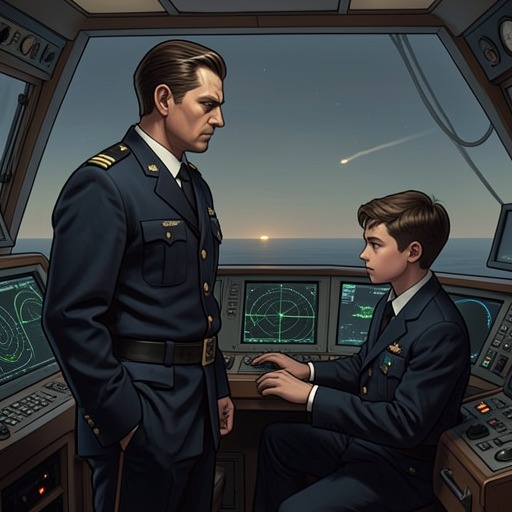
Cole is introduced at work in the chartroom, where the improvised combat information centre has developed aboard Keeling. Krause treats him as a trusted colleague, telling him how matters stand and warning that a surfaced U-boat may soon appear on the radar screen. Their familiarity is professional as well as personal: the narrative identifies Cole as an old friend, but their exchanges remain shaped by naval rank and responsibility.
The partnership depends on communication between the bridge and the chartroom. Cole reports from below, while Krause must make decisions at the point where tactical information, ship handling, and the safety of the convoy meet. When ASDIC sonar temporarily fails after underwater explosions, the captain has to contend with a deafened instrument and a contact that may be escaping. Cole’s role in this larger sequence belongs to the ship’s network of reports and responses: information has to move through the command structure even when equipment and circumstances are unreliable.
Cole is also present when the immediate work gives way briefly to recognition. After the sinking of a U-boat, he comes up from the chartroom smiling to congratulate Krause. The exchange is short, but it marks their shared participation in the operation; Cole is not simply a voice below decks, but a colleague who understands what the result means. He then turns the captain’s attention to another unresolved responsibility, the matter of Flusser, showing how quickly operational success is followed by further demands.
Maintaining the Crew Through Prolonged Action
Cole’s care for the ship’s company is expressed through concrete arrangements rather than speeches. After a long period at battle stations, he reports that Sections Three and Four have the watch and have been fed, while Sections One and Two are receiving their meal. Krause asks him to see that the men rest afterward, especially because those sections will need to be fresh for the midnight-to-four watch. Cole warns that many will not settle down unless someone makes them; Krause answers that he must make them, and Cole accepts the responsibility.
That exchange reflects a wider strain aboard Keeling. General Quarters takes every man from ordinary duties, interrupts eating and sleep, and cannot be sustained indefinitely. Condition Two is less immediately exhausting, but it still burdens the crew and complicates the ship’s routine. The shortage of trained ratings has led Krause to divide the company into four sections and use a watch-and-watch arrangement; the added weapons and equipment have also strained the available living space. Cole’s reports about meals and rest show this policy being put into practice at the level of daily shipboard life.
Krause relies on Cole not only to carry out instructions but to help preserve the crew’s capacity for the next emergency. After the captain decides there will be no routine General Quarters before dawn, he explains that the men are already keyed up and that the watch below should receive a full four hours unless an emergency intervenes. The decision is part of a broader effort not to impose unnecessary strain. Cole’s practical work—feeding sections, getting them to rest, and carrying the captain’s orders through the ship—helps make that conservation of human endurance real.
Mutual Oversight and the Limits of Endurance
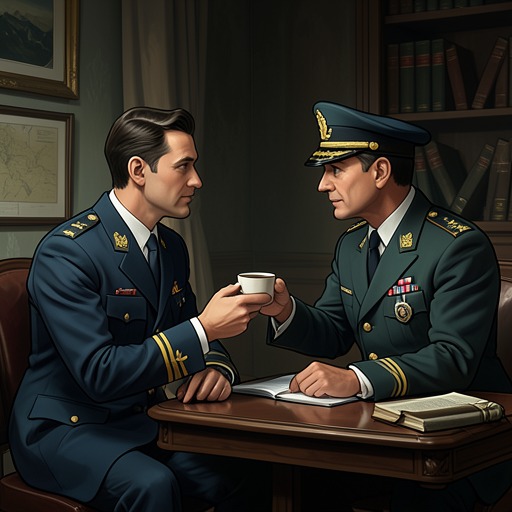
Their concern for one another runs in both directions, though the responsibilities are unequal. Krause notices the signs of Cole’s exhaustion: his usually careful appearance has given way to a drawn face and a thick growth of beard. He learns that Cole has spent most of the night in the plot and asks whether he has eaten. When Cole begins to leave to attend to another matter, Krause stops him, orders him to eat a good breakfast, and then directs him to sleep for at least two hours. Cole obeys.
The episode makes plain that Cole’s usefulness does not exempt him from bodily limits. He has continued working through the night in the plotting space, while the ship’s demands make it easy for officers to treat rest and food as postponable. Krause’s order interrupts that pattern. Their friendship permits an intimacy of observation, but Krause makes the intervention in his official capacity: care takes the form of a command because the executive officer’s fatigue is itself a concern for the ship.
Cole, in turn, notices what Krause neglects. Later, after a succession of watches has blurred the captain’s memory of when he last ate, Cole asks when he had his last meal. Krause can recall only that he has had coffee. Cole’s attention to this omission balances the earlier scene: the captain who enforces rest for his subordinate is also a man whom his subordinate has to remind to eat. Their working relationship is sustained by mutual vigilance, even though Krause bears the final authority.
Ceremony, Command, and the Dead
Cole also assumes responsibility for the ship’s formal response to its first deaths under Krause’s command. When the question of funerals is raised, Krause initially has not thought about burying the dead; tactical problems have occupied his attention. After consulting the doctor, Cole helps bring the matter before the captain. Krause authorizes him to give the necessary orders, using the formal language of command to reassert control over a responsibility that cannot be left unattended.
Cole organizes the burial at sea from the main deck aft. His loudspeaker announcement specifies which representatives from each division are to attend and instructs the rest of the company to mark the solemn occasion by remaining at their posts. The arrangement joins ceremony to duty: the ship honors the dead without abandoning the living work still required of it. Krause recognizes that Cole has organized the event well. From the bridge, Cole appears to signal at the right moment for the stretchers to be tilted; three bodies slide into the sea beneath flags, and three small volleys are fired over the water.
The ceremony gives Cole a distinct role in the aftermath of combat. He does not decide the tactical course that brought the ship into danger, but he ensures that its consequences receive proper attention. The burial also exposes the limits of Krause’s emotional reserve. Exhausted and preoccupied, the captain has been unable to feel the deaths as he believes he ought to; the organized ceremony provides an outward form of respect while his private response remains troubled and incomplete.
Operational Judgment and Narrative Role
Cole contributes to the ship’s work by observing and reporting rather than by displacing the captain’s authority. During a later contact, an unsatisfactory estimate of a radar pip is followed by Cole’s assessment that the bearing is constant and that there are two pips. His report supplies a useful distinction at a moment when the contact is still uncertain. Elsewhere, he arrives on the bridge after apparently making rounds of the ship, despite Krause’s initial suspicion that he had been asleep. His movement between the plot, the ship, and the bridge makes him a practical link across the command organization.
When the Admiralty informs Krause that Captain Earl will take over command, the captain passes the news to Cole, recognizing that his second-in-command must know of a change this important. Cole sees the prospect of relief as a chance for Krause to rest and says so; Krause’s harsh reply reveals that the news does not simply comfort him. The exchange shows Cole’s attentiveness to his friend’s exhaustion as well as his awareness of the command transition.
Near the end of the supplied sequence, a forward look-out reports that the object ahead is a ship. Keeling’s lamp and the answering light exchange signals, and Cole tells Krause that they have made it. The captain confirms it, his voice affected by a dry throat and his hands still unsteady. Cole’s brief statement gathers the strain of the passage into a shared recognition: survival is not presented as a solitary achievement, but as the result of a crew and command team that have kept working through uncertainty. Across the narrative, Cole’s steady presence is the human counterpart to Krause’s isolation in command—an officer who carries out orders, supplies observations, protects the crew’s ability to continue, and reminds the captain of obligations that combat cannot erase.